WHO WAS ANDRÉ LAMBERT WITHIN THE HISTORY OF JÁVEA ARTS?
THE ARCHITECTURAL AND SPIRITUAL GROWTH OF MEDIEVAL XÀBIA
* Report by Karla Ingleton Darocas, Hons. B.A. (KarlaDarocas.com)
VALENCIAN BAROQUE MASTERWORK BOASTS GREATEST FRESCO ART IN SPAIN
Velázquez, Politics, and "Los Borrachos
(c) KarlaDarocas.com
GRAND SCALE CHURCH BRINGS CLASSICAL BEAUTY AND HISTORICAL LEGACY TO OLIVA
![]() |
| FRONT and BACK |
GREAT NEWS * VALENCIA MUSEUM COLLECTION GROWS WITH MORE TREASURES
The collection of paintings, which has been considered a jewel of the Lladró family for years, will no longer be hidden from the eyes of the public!
I was delighted to hear that the descendants of the Lladró family, who have become famous and wealthy through their brand of luxury porcelain produced in their own factory in Tabernes Blanques since 1958, have donated their entire collection of paintings and artefacts to the city of Valencia.
In 1980, Juan Lladró began investing in art with his brothers José and Vicente. He did this on the advice of Alfonso Emilio Pérez Sánchez, the director of the Prado Museum between 1983 and 1991. His idea from the beginning was to make the artwork in the headquarters of the porcelain figurine company in Tavernes Blanques accessible to the public. And there it remained until the company was sold to an investment fund in 2017 and the art collection was moved to Madrid, where it is stored.
** Report by Karla Ingleton Darocas, Hons. B.A. Fine Arts (KarlaDarocas.com)
A ROMANTIC ETCHING OF JAVEA
I saw this etching of the fortress church of San Bartolomé on Facebook and no one was talking about it, so I grabbed it. At first, I thought it belonged to the Parisian artist Andre Lambert, who settled in Jávea around 1920 and made his paradise on the Costa Blanca a meeting place for international figures from the world of art and culture. His ashes have been part of the Portichol pine forests since his death in 1967
I looked at his etchings again, but this one did not belong to him. So after a lot of research on Google, I do not know who it belongs to.
** Report by Karla Ingleton Darocas (KarlaDarocas.com)
NEOCLASSICAL GREATNESS BEFORE THE AGE OF 50
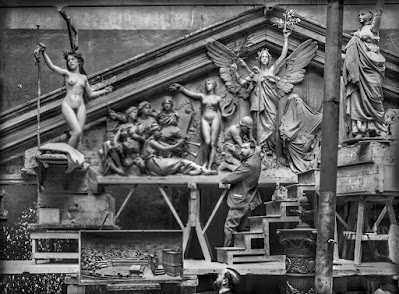
Querol in his workshop - 1892
To achieve great things before the age of 50, you need a very positive attitude and the belief that you can achieve everything you set out to do.
Report by Karla Ingleton Darocas (KarlaDarocas.com)
This was the case with the neoclassical sculptor Agustín Querol y Subirats (Tortosa, 1860-Madrid, 1909), who achieved amazing success before he died at the age of 49.
NEOCLASSICAL TRUTH WITHOUT FLATTERY
The woman in this 1836 portrait is a Madrid aristocrat, Señora Delicado de Imaz. This woman is of an age and affluence where she is not interested in being painted as an object of desire, but as a woman of elevated society and enlightenment. She is a woman for whom wealth and power are more important than beauty and frivolity.
* Report by Karla Ingleton Darocas, Hons. B. A. (KarlaDarocas.com)
THE EVOLUTION OF SPANISH NEOCLASSICAL ARTISTS & PAINTINGS * tba
IN THIS LECTURE we will look at the visual development of the neoclassical style of painting in Spain from the mid-18th to the early 19th century. We will look at the most important painters of this period and their defining works. We will also examine the elements that characterise Spanish Neoclassicism as an academic standard that would prevail into the modern era.
THE TERRIFYING SUBLIME * GOYAS MOST PROVOCATIVE PAINTINGS * TBA
In this lecture we explore a genre of visual art that Goya spearheaded. While others were painting beautiful pictures, Goya was breaking the boundaries of established art aesthetics. The paintings in this lecture were not commissioned works, but self-created, so Goya had the freedom to realise his ideas
* Report by Karla Ingleton Darocas. Hons. B. A. (KarlaDarocas.com)
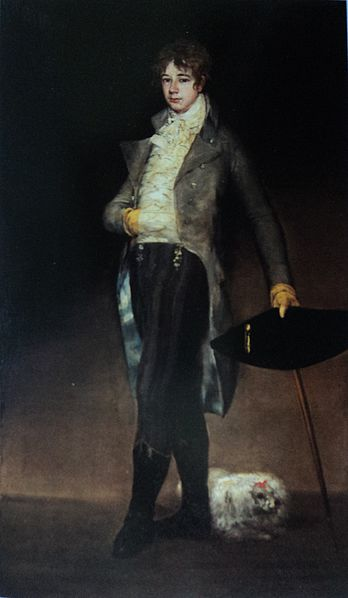
JAVIER GOYA AND HIS DOG
DOGS OF LEISURE
After the war between Spain and the First French Empire, which began in 1808 with the invasion of Napoleonic troops and ended in 1814 with the return of Fernando VII to Spain and absolute power, Spain was destined to shake up its social structures with the emergence of diversified social classifications.
There were still the noble families with land titles and wealth, and of course the peasants who owned nothing, but now there was a newly emerged stratum in Spanish society based on the wealth created by trade, manufactures, modern agriculture, retail, professions such as doctors and lawyers, and even arts and crafts. These self-employed people and family businesses formed a social class based on materialism and the pursuit of respectability called the bourgeoisie.
The bourgeoisie was now the class of people who wanted companion dogs to demonstrate their ability to spend their leisure time, and so the miniature dog breeds made a big comeback. Small dogs were now a symbol of success, a happy family life and a home because they had a good income.
-
Since returning from our fabulous four-day SpainLifestyle Baroque & Renaissance Road Trip, many of my friends and colleagues have a...
-
A small Valencian family distillery in the old stables of the Palau del Marquès de Malferit, could be the origin of one of the emblems of c...
-
THE ENIGMA Dionisio Fierros (1827-1894) was a Spanish Romantic painter who painted a “Vanitas”, an allegorical still life, for the Marquis ...