

Since returning from our fabulous four-day SpainLifestyle Baroque & Renaissance Road Trip, many of my friends and colleagues have asked me what the highlight of the trip was?
While there were many personal highlights, from an artistic and academic perspective, I think it was the painting La Mujer Barbuda by Jusepe de Ribera at the Prado Museum in Madrid, which I finally got to see up close. It had recently been transferred to the Prado from the Museo Fundación Lerma in the Hospital de Tavera in Toledo.
Report by Karla Ingleton Darocas, B.A. (Hons) for SpainLifestyle.com . KarlaDarocas.com
Ribera created this work in 1631 as a commission for the Viceroy of Naples, Fernando Afán de Ribera y Enríquez (1583-1637), who was a collector of academic and scientific marvels. The painting was part of his personal inventory, but was sold after his death in Genoa.
Eventually, the painting passed by inheritance into the collection of the Duke of Medinaceli. In 1808, at the beginning of the Napoleonic Wars, it was taken to the Napoleon Museum in Paris and exhibited there.
Five years later, the painting was returned to Spain by order of Louis XVIII, but it was not until 1829 that it was recovered by its rightful owners and once again became part of the Medinacile collection.
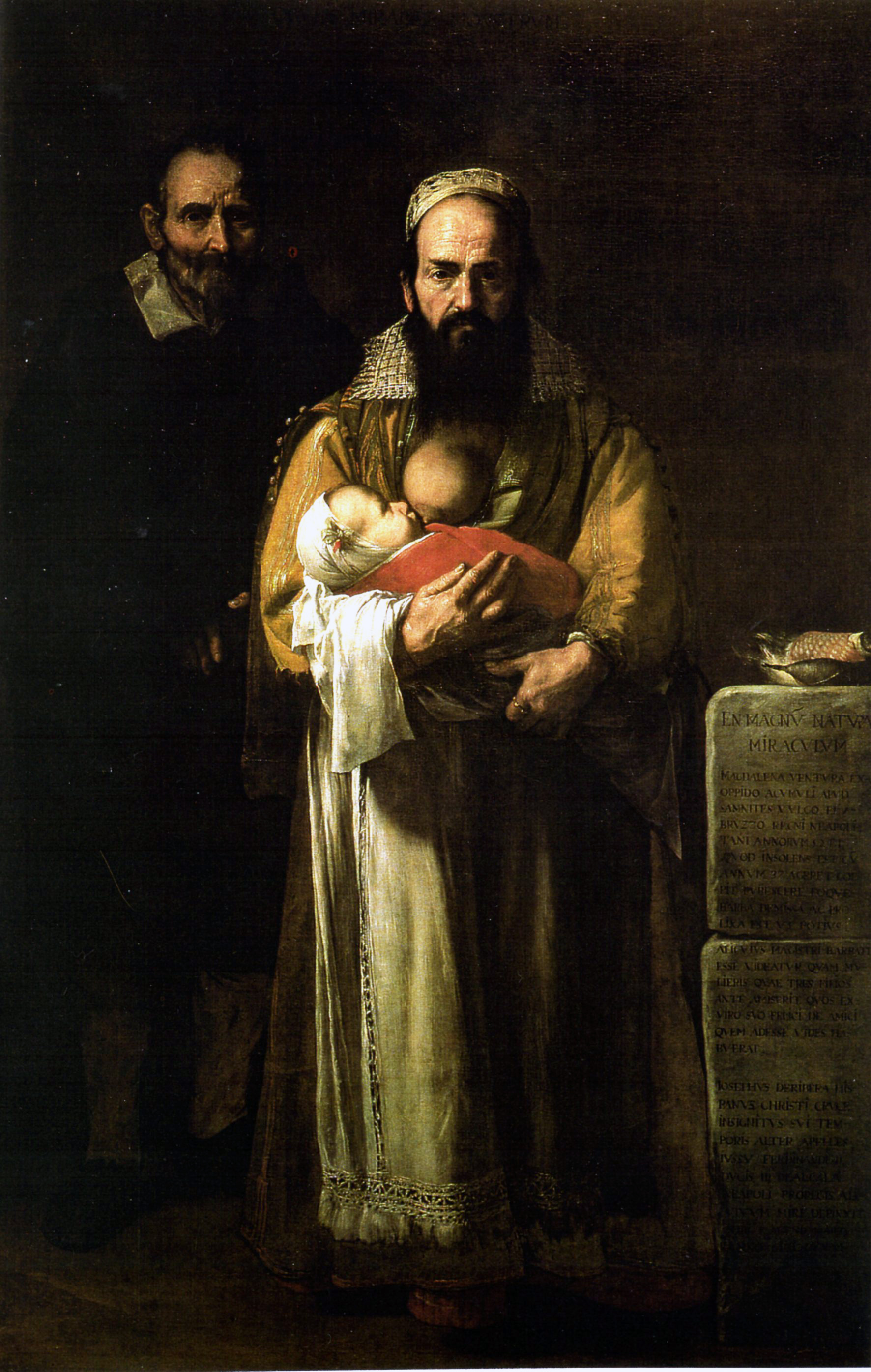
Full painting
THE STORY BEHIND THE PAINTING
When the Viceroy of Naples heard about a bearded woman living nearby, he invited her to his palace to be painted by his favourite Valencian artist, Jusepe de Ribera.
This masterpiece actually tells its own story! Look closely at the stone tablets on the right side of the frame; the long Latin inscription is packed with fascinating details.
Entitled "The Great Miracle of Nature," it reveals that her name was Magdalena Ventura, from the Abruzzo region of Italy. She was 52 years old when she posed for this 1631 portrait, standing next to her husband, Felici di Amici, and the youngest of their three children.
According to the text, Magdalena moved to Naples at age 37, which is when her beard, body hair, baldness, and deep voice first began to develop.
Modern scholars and scientists classify her condition as a hormonal imbalance called hirsutism.
THE WORK
Those of you who have studied Jusepe de Ribera (1591–1652) with me know that he wanted to reproduce nature in its purest form. This painting demonstrates the artist's desire to render Magdalena truthfully as a natural phenomenon, which was undoubtedly the client's wish. At the same time, Ribera also wanted to create a masterpiece that would bring him further renown.
Ribera's ambition to pursue a naturalistic form of hyperrealism must have been deeply impressive to viewers of the era. While we are accustomed to close-up shots in modern films and photography, 17th-century citizens found Ribera's paintings truly shocking. In fact, his visceral style still shocks the senses today!
The technical execution is fascinating, especially considering that paintbrushes in that era consisted merely of horsehair bound to a wooden stick.
In keeping with the Baroque trend of dramatic lighting, the background remains dark, flat, and almost neutral, contrasting sharply with the illuminated subjects.

Ribera perfectly emphasizes Magdalena's masculinity through her long, black, natural beard and bushy eyebrows. She stands equal in height to her husband, who is positioned behind her in the half-shadow.
Her hands appear strong as she holds her child to her breast, which subtly protrudes from her blouse. Rather than depicting her seated like traditional breastfeeding mothers, Ribera portrays Magdalena standing, a choice that underscores her physical strength and masculine qualities.

Yet, Ribera ensures the audience recognizes that Magdalena is undeniably a woman and a mother. She is depicted wearing a long dress and an apron with a finely crocheted border. She also wears a wedding ring on her index finger, a common practice during that era.

Finally, atop the stone tablet on her left (our right) rests a spindle wrapped with wool, serving as a clear symbol of female domesticity. Interestingly, this spindle is placed inside a large snail shell.
Some art critics believe Ribera included the shell to allude to the Greek mythological figure Hermaphroditos, the son of Hermes and Aphrodite. This inclusion suggests a parallel to Magdalena's dual characteristics, as a snail shell represents a hermaphroditic organism possessing both male and female traits.

SOCIOLOGY
From the Renaissance onward, a growing societal interest emerged in science, alongside Greek and Roman mythology. By the Baroque era, however, this perspective was filtered through a Catholic Counter-Reformation mindset. Consequently, individuals with unique physical conditions were viewed as more than just scientific or mythological curiosities; they were seen as special cases touched by a divine gift.
Teratology, the study of physiological abnormalities, became highly fashionable and prestigious among the 17th-century nobility. Aristocrats patronized unusual individuals not out of altruism, but for the social status it brought them. As seen in the works of Diego Velázquez, his royal patron King Felipe IV kept numerous court dwarfs.
Magdalena likely benefited financially from this trend. Ribera implies she held a higher status than her husband, serving as the family's primary breadwinner. Her husband is depicted with modesty and a gentle smile, occupying a subordinate position in the shadows behind her. His beard is smaller and his physique slimmer, highlighting how Magdalena’s unique presentation made her a celebrity in Italy.
It was not just royals who paid to see such individuals; the general public did as well, driven by various motivations. First, audiences experienced a simultaneous fascination and repulsion in their presence. Second, unique individuals were often viewed as symbolic links to the supernatural or even as good luck charms. For instance, dwarfs were sometimes paraded through taverns, collecting money from patrons who kissed their feet for good fortune. Third, and most exploitative, nobles sought audiences with people like Magdalena to appear more beautiful, wealthy, and healthy by comparison.
CONCLUSION
Standing in the Prado Museum explaining Jusepe de Ribera's La Mujer Barbuda to my students, I closely examined the piece to understand the artist's mindset. At this stage in his career, Ribera was highly regarded by his peers and patrons. Yet, his social status mirrored that of many talented craftsmen in Naples, classified by society according to his own divinely granted gifts.
Magdalena stands out in all her authentic originality. Ribera captured her eyes in meticulous detail, reflecting a deeply dignified expression. She appears proud as both a mother and a wife, her profound humanity rising above her physical differences.
Given Ribera's dedication to capturing unvarnished reality, Magdalena served as an extraordinary subject. Their time together forged a genuine connection between painter and sitter. In an era when women in art were strictly categorized as goddesses, saints, or martyrs, Ribera looked past conventional boundaries. His portrait of Magdalena champions a humanistic truth: even when someone defies societal expectations, their unique dignity must be honored.
Through his art, Ribera made Magdalena immortal.
*******APPRECIATE ART & CULTURE * LOVE SPAIN
Study Guides written by
Karla Ingleton Darocas
and published by
SpainLifestyle.com
Study Guides written by
Karla Ingleton Darocas
and published by
SpainLifestyle.com


