WHO WAS ANDRÉ LAMBERT WITHIN THE HISTORY OF JÁVEA ARTS?


Many of you who have walked around Jávea on my Historical Jávea Walk will have passed a palace called Casa Lambert, preserved by the family of the French-Swiss painter André Lambert as an art school and exhibition space for community artists.

Who was Lambert, and why was he so involved in the cultural life of Jávea?

* Report by Karla Ingleton Darocas, Hons. B.A. (KarlaDarocas.com)

THE ARCHITECTURAL AND SPIRITUAL GROWTH OF MEDIEVAL XÀBIA


In the past, settlers from many different cultures have inhabited and enjoyed this exclusive place. The name could very well come from the Arabic "Xibìa", meaning "abundant".
Xàbia or Jávea is a Valencian coastal town in the Marina Alta region (Alicante). It has always been a privileged and strategic place on the Mediterranean, attracting ancient Greeks, Romans, Arabs and Christians.

* Report by Karla Ingleton Darocas, Hons. B.A. (KarlaDarocas.com)

VALENCIAN BAROQUE MASTERWORK BOASTS GREATEST FRESCO ART IN SPAIN


The parish church of San Nicolás de Bari and San Pedro Mártir in Valencia houses one of the greatest wonders of fresco painting that Spain has to offer. This historic parish church is located in the city centre and thanks to an extensive restoration in 2016, this place of worship is now a tourist and cultural showcase known as "The Sistine Chapel of Valencia".

This designation is not entirely logical, since San Nicolás is a single-nave church with six sections, twelve side chapels with buttresses (two of which are occupied by side entrance doors) and a magnificent polygonal presbytery facing east. The Sistine Chapel, on the other hand, is only one "chapel" in the Apostolic Palace, the official residence of the Pope (Vatican City).

In any case, one statement is true: San Nicolás is indeed one of the best examples of the juxtaposition of 15th century Valencian Gothic architecture and a spectacular 17th century Valencian Baroque masterpiece. Let's take a look...

* Report by Karla Ingleton Darocas, Hons. B.A. (SpainLifestyle.com) (C) no part of this text or photos may be replicated)


Velázquez, Politics, and "Los Borrachos

Diego Velázquez (1599–1660), a master of the Spanish Baroque and key inspiration to the Impressionists, cemented his status as court painter to King Felipe IV after winning a prestigious 1627 competition against older rivals. 
Painted in 1629, Los Borrachos (The Drunks) stands as his first major mythological work, skillfully blending the youthful, luminous figure of Bacchus with the gritty, picaresque realism of common men in a style that influenced later masterpieces. 
This Baroque scene, housed in the Prado Museum, blends moral commentary with humor, reflecting the influence of Rubens and the naturalism found in Cervantes' Don Quixote. For a detailed analysis of this artistic period, read more in this report by Karla Ingleton Darocas for SpainLifestyle.com.

(c)  KarlaDarocas.com 

GRAND SCALE CHURCH BRINGS CLASSICAL BEAUTY AND HISTORICAL LEGACY TO OLIVA

FRONT and BACK
Oliva is a pretty and lively town on the outskirts of the province of Valencia in the region of Safor, which has a very beautiful, stylish and colossal neoclassical church in its centre.

The parish church of Santa María la Mayor represents the historical, cultural and spiritual development of the Valencia region in its architecture. Let's take a look...

* Report by Karla Ingleton Darocas, Hons. B.A. (SpainLifestyle.com) (C)  (KarlaDarocas.comno part of this text or photos may be replicated) 

GREAT NEWS * VALENCIA MUSEUM COLLECTION GROWS WITH MORE TREASURES

The collection of paintings, which has been considered a jewel of the Lladró family for years, will no longer be hidden from the eyes of the public!

I was delighted to hear that the descendants of the Lladró family, who have become famous and wealthy through their brand of luxury porcelain produced in their own factory in Tabernes Blanques since 1958, have donated their entire collection of paintings and artefacts to the city of Valencia.

In 1980, Juan Lladró began investing in art with his brothers José and Vicente. He did this on the advice of Alfonso Emilio Pérez Sánchez, the director of the Prado Museum between 1983 and 1991. His idea from the beginning was to make the artwork in the headquarters of the porcelain figurine company in Tavernes Blanques accessible to the public. And there it remained until the company was sold to an investment fund in 2017 and the art collection was moved to Madrid, where it is stored.

** Report by Karla Ingleton Darocas, Hons. B.A. Fine Arts  (KarlaDarocas.com)

A ROMANTIC ETCHING OF JAVEA

I saw this etching of the fortress church of San Bartolomé on Facebook and no one was talking about it, so I grabbed it. At first, I thought it belonged to the Parisian artist Andre Lambert, who settled in Jávea around 1920 and made his paradise on the Costa Blanca a meeting place for international figures from the world of art and culture. His ashes have been part of the Portichol pine forests since his death in 1967 

I looked at his etchings again, but this one did not belong to him. So after a lot of research on Google, I do not know who it belongs to.

** Report by Karla Ingleton Darocas  (KarlaDarocas.com)

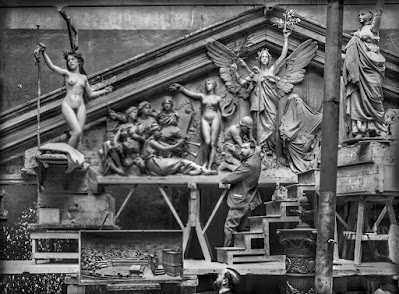
NEOCLASSICAL GREATNESS BEFORE THE AGE OF 50

 Una mirada fotográfica al taller del artista - hoyesarte.com
Querol in his workshop - 1892

To achieve great things before the age of 50, you need a very positive attitude and the belief that you can achieve everything you set out to do.

Report by Karla Ingleton Darocas  (KarlaDarocas.com)

This was the case with the neoclassical sculptor Agustín Querol y Subirats (Tortosa, 1860-Madrid, 1909), who achieved amazing success before he died at the age of 49.

NEOCLASSICAL TRUTH WITHOUT FLATTERY

The woman in this 1836 portrait is a Madrid aristocrat, Señora Delicado de Imaz. This woman is of an age and affluence where she is not interested in being painted as an object of desire, but as a woman of elevated society and enlightenment. She is a woman for whom wealth and power are more important than beauty and frivolity.

* Report by Karla Ingleton Darocas, Hons. B. A.  (KarlaDarocas.com)