NEOCLASSICAL GREATNESS BEFORE THE AGE OF 50

 Una mirada fotográfica al taller del artista - hoyesarte.com
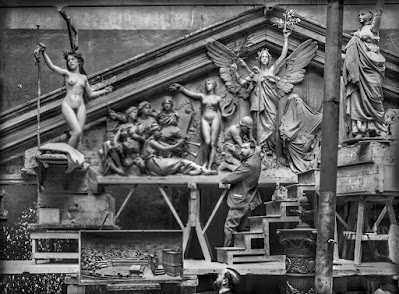
Querol in his workshop - 1892
To achieve great things before the age of 50, you need a very positive attitude and the belief that you can achieve everything you set out to do.

Report by Karla Ingleton Darocas  (KarlaDarocas.com)

This was the case with the neoclassical sculptor Agustín Querol y Subirats (Tortosa, 1860-Madrid, 1909), who achieved amazing success before he died at the age of 49.

NEOCLASSICAL TRUTH WITHOUT FLATTERY

The woman in this 1836 portrait is a Madrid aristocrat, Señora Delicado de Imaz. This woman is of an age and affluence where she is not interested in being painted as an object of desire, but as a woman of elevated society and enlightenment. She is a woman for whom wealth and power are more important than beauty and frivolity.

* Report by Karla Ingleton Darocas, Hons. B. A.  (KarlaDarocas.com)

THE EVOLUTION OF SPANISH NEOCLASSICAL ARTISTS & PAINTINGS * tba


IN THIS LECTURE we will look at the visual development of the neoclassical style of painting in Spain from the mid-18th to the early 19th century. We will look at the most important painters of this period and their defining works. We will also examine the elements that characterise Spanish Neoclassicism as an academic standard that would prevail into the modern era.

THE TERRIFYING SUBLIME * GOYAS MOST PROVOCATIVE PAINTINGS * TBA


In this lecture we explore a genre of visual art that Goya spearheaded. While others were painting beautiful pictures, Goya was breaking the boundaries of established art aesthetics. The paintings in this lecture were not commissioned works, but self-created, so Goya had the freedom to realise his ideas 

* Report by Karla Ingleton Darocas. Hons. B. A.  (KarlaDarocas.com)

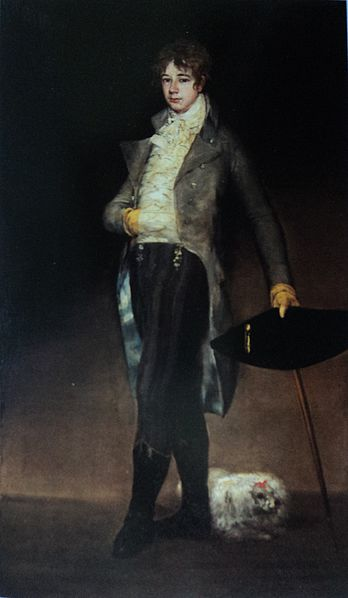
JAVIER GOYA AND HIS DOG

DOGS OF LEISURE

After the war between Spain and the First French Empire, which began in 1808 with the invasion of Napoleonic troops and ended in 1814 with the return of Fernando VII to Spain and absolute power, Spain was destined to shake up its social structures with the emergence of diversified social classifications. 

There were still the noble families with land titles and wealth, and of course the peasants who owned nothing, but now there was a newly emerged stratum in Spanish society based on the wealth created by trade, manufactures, modern agriculture, retail, professions such as doctors and lawyers, and even arts and crafts. These self-employed people and family businesses formed a social class based on materialism and the pursuit of respectability called the bourgeoisie. 

The bourgeoisie was now the class of people who wanted companion dogs to demonstrate their ability to spend their leisure time, and so the miniature dog breeds made a big comeback. Small dogs were now a symbol of success, a happy family life and a home because they had a good income.

REVIEW * CLASS TRIP TO XATIVA FINE ART MUSEUM * OCT.16, 2022


Xàtiva was called Saetabis in Roman times and was famous for its linen fabrics, mentioned by the Latin poets Ovid and Catullus. Xàtiva is also known as an early European centre of papermaking. In the 12th century, the Arabs brought the technology for making paper to Xàtiva (Arabic: Shāṭiba). It is the birthplace of two popes, Callixtus III and Alexander VI, and also of the painter José Ribera.


We had the most beautiful weather to explore Xàtiva and visit the museums. After parking, we went to the main market to have a coffee, but nothing was open yet. We decided to try the main street where all the cafés were open, and the coffee was delicious. A marathon race was about to start, and we watched while enjoying our coffee.

* Report by Karla Ingleton Darocas. Hons. B. A.  (KarlaDarocas.com)

ART TALK * GOYA GRANDEUR * tba


In this Talk we will compare two paintings by Francisco Goya. The first is entitled The 3rd of May 1808 in Madrid, or "The Executions". It was painted in 1814 after Fernando VII returned to Madrid. It is archived in the Prado Museum in Madrid. 

The second painting is called Saturn Devouring His Son. Goya painted this work directly on the wall of his house on the outskirts of Madrid between 1819 and 1823. It is kept in the Prado Museum in Madrid.